Sailboat or Catamaran on the Tagus: The Difference That Shows Up on Board
Updated September 17, 2026 · 8 min read
Something in the numbers is easy to miss. Lisbon’s big motor cruises – the €15 to €18 boats that carry thousands of reviews – sit between 3.8 and 4.3 stars. The heavily reviewed sailing boats and sailing catamarans, at €25 to €60, sit at 4.7 to 5.0. Across our stock of 122 river offers, that gap is the most consistent thing in the category.
It is not that the sailing boats have a better river. They have the same river. What they have is fewer people on it, no engine noise for most of the trip, and a crew that is sailing rather than narrating. If you have already decided you want that, the remaining question is which hull – and the answer changes the trip more than the price does.
What the two hulls actually do differently
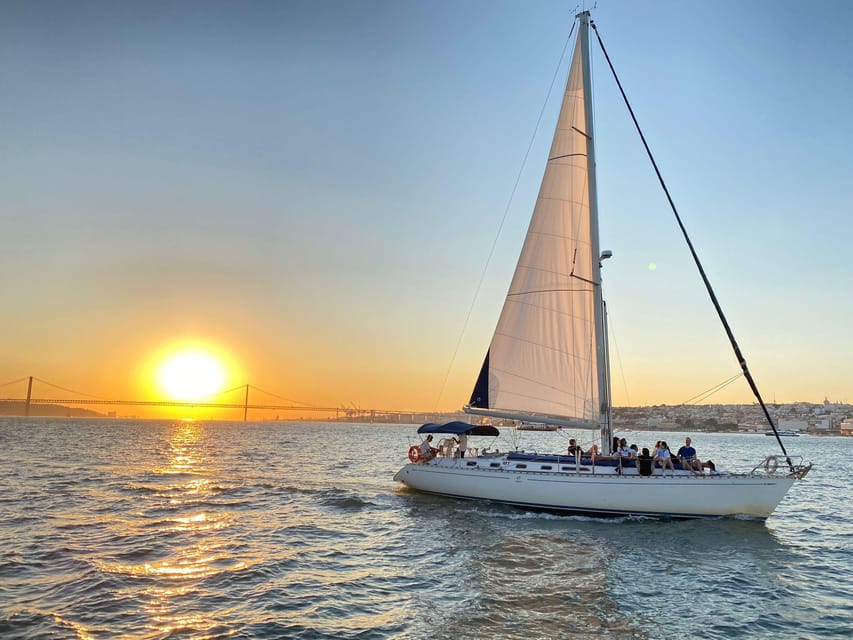
A monohull – a “sailboat” or “sailing yacht” – leans. Under sail it heels over, the deck tilts, and you sit on the high side. That is the sensation people mean when they say they went sailing. It also means a narrow deck, a cockpit you share at close quarters, and a companionway down to a small cabin. Capacity at the Tagus’s largest sailing operator: 10 to 12 people; a few bigger yachts in the catalogue take up to 18.
A catamaran stays flat. Two hulls, a wide deck between them, and – on most of Lisbon’s boats – trampoline nets stretched across the bow that you can lie down on. Nothing tips. You can walk around with a full glass. At the same operator: 12 to 14 people, so slightly more company for a lot more space.
Neither is better. They answer two different wishes:
- If the sailing is the point – the heel, the wind, the sense of being on a boat that is working – take the monohull.
- If the sitting is the point – the nets, the flat deck, a drink that stays in the glass – take the catamaran.
There is a practical version of that too. Anyone who is uneasy on water, or travelling with someone who is, will have a calmer ninety minutes on the catamaran. The Tagus inside the city is sheltered and generally flat, so this is rarely dramatic either way – but the tilt of a monohull is the part people did not expect, and a crowded leaning deck is a long way from relaxing if you are gripping the rail.
One booking, either boat – and the operator says so
This is the single most useful thing to know before you book, and it is stated openly in the fine print rather than hidden.
The best-known sailing listing in the city – the sailing tour on the Tagus from WaterScenery, €25 for one or two hours, 4.8 stars across 2,838 reviews – tells you in advance that it runs on either sailing boats for 10 to 12 people or sailing catamarans for 12 to 14, and that groups are split according to which boat is available. You are booking a sailing experience, not a specific hull.
For most people that is completely fine, and the rating says as much. But if you have a reason to want one or the other – seasickness, mobility, a child who will want to lie on the nets – book a listing that names the boat. The catamaran options say catamaran in the title. The yacht options say yacht.
The honest limitation of the whole sailing category
The same operator states it directly: this is not a guided tour, and the crew are not official guides.
That line applies, in spirit, to most of the sailing boats here. You get a skipper who knows the river and will point things out. You do not get the structured commentary that the big motor boats provide – and one of those, the landmarks cruise with a multilingual audio guide, costs €18 and does that job properly.
So if this is your first afternoon in Lisbon and you want to understand what you are looking at, the sailing boats are the wrong tool and the cheaper boat is the better one. If you already know the city and want two hours of it from the water, the sailing boats are why the ratings look the way they do. The full range of formats and what each one is for is laid out in which Tagus boat format suits whom.
The boats, side by side
| Boat | Hull | Duration | From | Reviews |
|---|---|---|---|---|
| Sailing tour on the Tagus | either | 1–2 hours | €25 | 2,838 · 4.8 |
| Sunset catamaran with welcome drink | catamaran | 1 h 30 min | €28 | 3,517 · 4.7 |
| Morning, day, sunset or night cruise | sailboat | 2–3 hours | €28 | 834 · 4.8 |
| Day and sunset tour on the Tagus | sailboat | 2 hours | €30 | 832 · 5.0 |
| Tagus sunset cruise with drinks | sailing yacht | 2 hours | €33 | 436 · 4.9 |
| City skyline sailboat cruise with drink and snacks | sailboat | 2 hours | €39 | 553 · 4.9 |
| Sailing boat tour with drinks and pastéis de nata | sailboat | 2 hours | €45 | 81 · 4.7 |
| Catamaran cruise with drinks and pastéis de nata | catamaran | – | €50 | 246 · 4.9 |
| Sunset sailing cruise with wine | sailboat | 2 hours | €55 | 804 · 4.9 |
| Sunset sailing tour on a luxury yacht | sailing yacht | 2 hours | €60 | 172 · 4.9 |
Read down the rating column and the case for spending more gets thin. Between €25 and €60 the ratings barely move – 4.7 to 5.0 the whole way. What the extra €30 buys is not a better boat. It is a smaller group, a glass of wine instead of a soft drink, or two pastéis de nata handed round on the way back. Those are real things to want. They are not quality differences.
What the crew decides on the day, and why that is a feature
The Tagus is tidal, it is wide, and it funnels wind between the hills of Lisbon and the Almada bank. Sailing operators state that the route may be changed according to the tide and wind conditions, decided by the crew on the day of the tour.
On a motor cruise a fixed route is a promise. On a sailing boat it is a limitation, because a sailing boat goes where the wind lets it sail properly. A crew that changes plan is a crew that is using the wind instead of motoring against it – which is the thing you paid for. Expect the Ponte 25 de Abril, Praça do Comércio, the Torre de Belém and Cristo Rei; do not expect them in a guaranteed order.
One more practical note from the same operator, and it is the kind that gets forgotten: for sunset tours, bring something warmer. Most Lisbon evenings are mild, but the temperature on open water after the sun goes down is not the temperature on the quay when you boarded.
Where they board
Almost all of the sailing boats and sailing catamarans lie at Belém or the Doca de Belém, seven kilometres west of Praça do Comércio, and some at Doca de Santo Amaro under the Ponte 25 de Abril. Neither is central. Add half an hour of travel in each direction and build the boat into a Belém day rather than treating it as an evening stroll from Baixa – the monastery, the tower and the tarts are all within walking distance of the pontoon, and the tickets for them are on our Lisbon attraction tickets page.
The big motor boats, by contrast, board in the middle of town at the Estação Fluvial Sul e Sueste. That is a genuine trade-off in the sailing boats’ favour on the water and against them on land.
Children, and what counts towards the boat
Sailing boats have small, fixed capacities, and that has one consequence parents should know: operators require that infants and children are named in the booking, because they count towards the boat’s maximum occupancy – a lap is still a place. The same operator requires that children board with adult supervision.
That is a different world from the party boats, whose conditions list children under 18 as unsuitable. The full picture on ages, life jackets and what is actually on board is in a Tagus boat trip with children.
For a group of four or six adults, the small capacity cuts the other way and is worth pricing out properly: at €33 to €60 a head, a private boat stops being the extravagant option surprisingly early.
Every sailing boat and catamaran currently bookable, with prices and availability, is on our Lisbon boat tours page. Capacities, route decisions and conditions are the operators’ own, and the booking page is the version that counts.